Showing posts with label Goiania. Show all posts

Friday, January 3, 2014

Armadillos or Tattoos

By the title, you might think I'm deciding on a hobby... or whittling down some strange list of New Year's Resolutions...

Not quite.

For anyone unfamiliar with the creature that is the official mascot for the upcoming World Cup in Brazil, you might be surprised to learn that it is an armadillo, or tatu (pronounced: "tattoo"), as it is known in Portuguese.

Up until now, most people didn't associate Brazil with armadillos — parrots or jaguars, sure. Amazon river dolphins and stinkbirds, maybe. I don't recall seeing an armadillo in the movie Rio, either.

This energetic mascot needed a campaign all his own, I guess.


"Fuleco," (pronounced: "fool-ay-koh") is a colorful, playful rendition of a Brazilian three-banded armadillo that is one of the two species of armadillo that can roll into a ball. What better mascot for soccer?

As a Texan, I must say that Fuleco is one of the two cutest renditions of an armadillo that I've seen.

When I first moved to central Brazil, I was surprised to hear that Texas didn't have the market cornered on these armored creatures. A fellow Texan was even more surprised when he learned that some armadillos are actually eaten in certain regions of the country.

That came with a disclaimer:


"...but [they] don't eat the ones that eat dead people, though."


Whew! That's a relief!

I suppose?

You know, that statement sounds like a line straight out of a Scooby Doo episode. Perhaps it's the Mystery Meat factor.

Mystery Meat is best experienced vicariously, in my opinion. (Especially if it's the kind that can give you, say, leprosy.)

Tourists need not worry that the kebab, or espetinho (pronounced: "eh-speh-cheen-yo") stand on the corner will be serving mascot, since the hunting and consumption of this creature is discouraged due to its endangered status. (That, and it's hard to come by in the big city. Kidding!)

Appropriately, Fuleco's very name reminds us to be eco-minded. On a related note, in Goiânia there is a slang term pronounced like the English word "echo" that is used in place of "ew, gross."

Monday, October 22, 2012

Some Things Don't Translate

...in this case I'm referring to good prices, and a certain slogan that assures me I can have things my way. Perhaps that is old school. Have things changed that much in six years? Then again, it could just be good ol' fashioned highway robbery. You be the judge.

Living in a place where you are hard-pressed to find home flavors can drive people to certain lengths (as I alluded to in my previous post). In my case, it drives me to occasionally eating fast food — fast food that is considered chic in a place where it isn't all that common. This can come with a hefty price tag, depending on where you go. On those days where I'd give a portion of my left pinky to taste something reminiscent of home, I think it's worth it.

On those days where I see a blatant disregard for the fact that the minimum monthly wage here is R$600, and someone is trying to charge people R$8.50 for less than (when you factor in ice — I measured it) a 10 oz cup of watered down soda [when you can by a 2.5 liter of coke for R$5-6 at any convenience store] ...I get peeved.

At first, I attributed it to some foreign company that doesn't have a clue about the cost of living here. ...but that can't be right, can it? Of course, how could anyone living here also live with their conscience, if they know that this is grossly overcharging people for a drink [thereby excluding a large portion of the population]? I know I couldn't do it.

All I know is that THIS is not right:


What's wrong with this picture? (Other than the gum that I wadded into this receipt out of disgust before deciding to rant online about it. Sorry about that!)


Please right-click and open in a new window to enlarge.


So if it was that expensive... why did I pay for it, and not stop by a convenience store?

Three reasons:
  1. I mistakenly heard a different total (trusty drive-thru intercoms), otherwise I would have amended it before I rounded the building, where my drink was already sticking out of the window. You see, they weren't finished making my burger, and I didn't want any extra "secret" ingredient.

  2. Unlike my hometown, convenience stores aren't all that easy to find, and with all of the one way streets in this town, it is actually anything but convenient. I thought about calling them not-quite-convenience stores, but that has a somewhat negative ring to it.

  3. I was starving, thirsty, and exhausted enough to not want to walk any extra step that I absosmurfly did not have to.
Although flagrant price gouging could be the norm for the other international fast food chains that are starting to pop up here, the prices are typically much, much less. I'm assuming that's because they want to achieve some measure of succe$$ with the population as a whole.

This is by far the worst case I've seen, yet. Other competitors such as McDonald's and Subway charge less than half of what was charged here (for the same size drink) making it a more affordable option for the masses.

I hope that the powers that be somewhere see this, and reign in their overcharging minions. I suspect they will see an increase in revenue, as more of the everyday people will be able to afford it.

I also suspect that they will need to invest in marketing that informs people that the idea of having a meal here is now more realistic for the average João.

Wednesday, March 28, 2012

Street Art in Goiânia


(To enlarge, right-click and open in a new window.)

Saturday, January 21, 2012

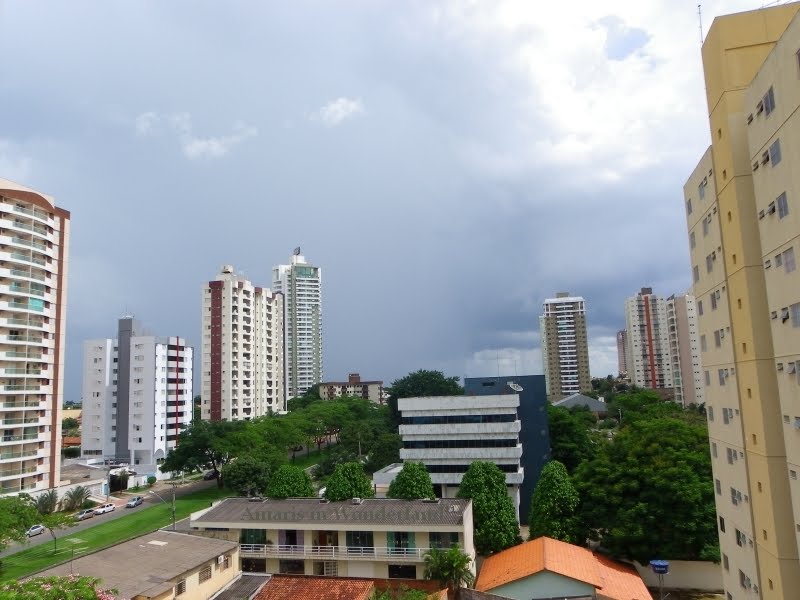
Room With A View

I love the rainy months here! It's like living in an ever-changing art display.

It always reminds me of home, too...

We have a saying in Central Texas, "If you don't like the weather, wait around a few hours - it'll change." During the rainy season here in Goiânia, the same is true.


This is what it looks like in the months just before the rains start.

Here are a few shots that I took from my apartment, this past November & December...


(That would be a wall of water headed our way...)


To give you an idea of just how big those clouds are, the tallest building in the back left of these pics is 25 stories tall. Some of the thunderheads that pass through these parts dwarf these concrete giants.


Cool, huh?


This one took out the electricity for a few hours...


This was an awesome sunset...

This year we've had more rain (sometimes, for days on end) intermixed with some surprisingly sunny spots. Some days start off with a scorcher of a sunrise...

Despite a strong showing at sunrise,

the storm clouds in the west were destined
to make a play for these rays...

...and usually make for the most interesting days of the week. I'm loving every minute of it! Maybe it's the "chillaxed" barometric pressure, but rainy days lift my spirits like nothing else.


(To enlarge pictures, right-click and open in a new window.)

Monday, November 14, 2011

The Good-Lookin' Capital City of Goiás

*This is a reprint of an article originally posted on my personal blog this past January. It is updated with additional pics & information.*


I thought i'd tell you a little about the capital city of Goiânia, Goiás. It shares many similarities with the capital city that i hail from: Austin, Texas.


Capitol in Austin, Texas at Night by Eric Hunt

  • Both are considered "small" for a capital city, although Goiânia is 13th-largest city in the country; and Austin is the 14th most populous city in the United States.
  • Both have a great live music scene.
  • Both are very safe cities in which to live. Goiânia is considered a safer city compared to most other state capitals within Brazil. The average yearly murder rate within the metro area stands at just under 450 persons per year according to the Goiás State Police. Austin is consistently ranked among the three safest cities per capita of any size in many categories. Its annual murder rate is fewer than five people per 100,000 residents.
  • Both are mistakenly thought of as Cowboy Capitals, where everyone owns a horse, wears boots and a ten-gallon hat.
  • Both are beautifully manicured, with more parks than other capital cities. Goiânia has the largest green area per inhabitant in Brazil, and is adding additional green areas under the newly-elected city & state government parties. Austin has 18,994.45 acres of land containing 251 parks, 15 preserves (sanctuaries for native plants, native animals and unique natural features), and 40 greenways (parkland on creeks and canyons).
  • Both are cities that have fluctuating residency, whether it be seasonal and/or temporary.


Austin, Texas Skyline along The Colorado River

Austin is a "College Town," (voted America's #1 College Town by the Travel Channel in 2006) which is quite evident during the summer months free of traffic and general congestion. Goiânia is very much the same, not only in the summer, but every 3-or-4-day holiday weekend. The city just empties: there is zero traffic - almost nobody on the streets, parking is available anywhere, and some stores simply do not open.

In Goiânia, a good portion of the population is from somewhere else - another similarity with Austin. Meeting a native"Goianiense" (person from Goiânia) on the streets of Goiânia is about as common as meeting a native Austinite in Austin. Most of the seasonal residents which make up the workforce are from the "interior" (country) small towns in Goiás, and go to see their families & hometowns, every opportunity they get. It is a little surreal to stay here in Goiânia during the holidays. It feels like a ghost town.

This is such a noisy city Monday through Saturday, 24 hours a day; so when everyone makes the big exodus it's weird - refreshing & calm, but weird. We go from this:


pic found here


...to this:


pic found here


Just like that.


People are always surprised that we don't "viajar" (travel) every holiday. This is another aspect to the paradise city of Goiânia. Jet setting appears to be a way of life for the middle & upper class. What i've been told, is that the upper class majority here in Goiânia are people that choose to live in a city where their money will go further; rather than live in Brasília, Rio de Janeiro or São Paulo, where the cost of living is much higher. This is most noticeable in the disproportionate number of high-end luxury sports cars & SUVs running the city streets.

For the 2010-2011 State of the World's Cities report by the United Nations Human Settlements Programme (UN-Habitat), Goiânia remained as the most economically unequal city of Latin America, with a Gini index above 60; while Brazil as a whole, has reached an all time low inequality index in the past five years. Apparently, Goiânia isn't following the national trend. However, Goiânia prides itself in being the sole metropolis in Brazil to have grown into a city with few homeless, and a noted absence of "favelas" (squatter settlements made from scrap materials) such as in Rio.


Viaduto Latif Sebba photo credit: Prefeitura de Goiânia


The fact that there are many people from the "interior" (country) has caused other Brazilians who are from larger, more international cities like Brasília, Rio de Janeiro or São Paulo, to remark that although Goiânia is a modern metropolis it still has a "small town mentality." People used to say the same about Austin - until they realized what a gem it is.


Parque Vaca Brava by Ian Nascimento


Overall, i have enjoyed living here. It has been a learning experience, a roller coaster ride and occasionally: a refreshing walk in the park. I hope that in the end i'll have not only earned an "E for Effort" with my peers and newfound friends here, but a "nota dez" (100%) in acquainting those back home with my new one.

Friday, November 11, 2011

Goiás, Brazil's Best Kept Secret

The World Cup is coming up in 2014. Do you know where it will be? The Olympics are all but around the corner, in 2016. Can you guess the locale? The answer to both questions is Brazil!

What comes to mind when you think of Brazil? Quick, 5 things:

If all that we know of Brazil is what the media tells us a few times a year, it went something like…
  1. Rio [de Janeiro]
  2. São Paulo
  3. Soccer
  4. Carnival
  5. Samba
    - (or possibly…) Victoria’s Secret Models
Wow. We can do a little better than that! You know, it’s similar to what I hear from people when they learn I’m from Texas… Wanna try? 5 Things – go!
  1. Cowboys (They don’t mean the NFL team.)
  2. Ranches (True. Although contrary to popular belief, they are outside of the city limits.)
  3. Desert (We have that, too. …in about 8% of the state.)
  4. Oil (We are blessed, it’s true. We also have natural gas, and a nearly unlimited supply of venison during the months of November through January.)
  5. And… “That’s where Bush is from, right?” (That is mostly correct. He was our governor, and has lived in Texas on & off, for most of his life; although he is actually from Connecticut. I’m pretty sure he sports one of the popular bumper stickers that we see everywhere that says, “I wasn’t born in Texas, but I got here as fast as I could.” I would. {{grin}})
Just as I like to broaden the horizons on what all makes up the beautiful & historic state of Texas, I’d like to introduce you to what is hailed by many as the “Brazilian Texas”…the state of Goiás, a state rich in biodiversity and natural beauty.

Centrally located, Goiás is the perfect launch point to any area of the country. Although landlocked, Goiás has many lakes, springs, rivers and waterfalls to explore. If beaches are more your thing, they are only a few short hours away by plane. Goiânia, the capital city of the state of Goiás lies only 125 miles away (45 minutes by plane, or 2 hours by car) from the country’s capital, Brasília. Just as Washington D.C. is a federal district, and not a part of any state, Brasília, D.F. is the same. Brasília is wholly encompassed by the beautiful state of Goiás, not far from one of the main gems of the state of Goiás, Chapada dos Veadeiros.


Chapada dos Veadeiros is a national park that is not only listed as a World Heritage Site, but due to the large amount of crystals in the ground, it is officially earth’s brightest spot, according to NASA. Within this 65,515-hectare slice of paradise there are mountains, waterfalls, exotic plants & animals, and a “Valley of the Moon” that even NASA would appreciate.

To the northwest, forming the border with the states of Tocantins and Mato Grosso, is the Araguaia River. Each year, as the Araguaia River starts to recede due to the annual period of drought, or dry season, miles of white sandy islands emerge in the middle of this large river. These temporary islands serve as campgrounds for the month of July, which draw thousands of vacationers during the peak of the season each year. For the rest of the dry season through October, fishermen make use of the biodegradable huts and structures left behind, until the river reclaims the islands with the return of the rains.


From one side of the state to the other, you will see sprawling ranchlands full of cattle, or expanses of farmlands that seemingly go on forever. The state of Goiás is a plateau that is covered in woodland savannah, or “Cerrado,” which is one of the richest regions in the world in biodiversity, boasting more than 1600 species of mammals, birds, and reptiles. Plants are the richest resource, though, with 10,000 different species in this region alone. There are several ice cream companies that sell a variety of fruit flavors found only in this cerrado. The exotic fruits and their corresponding flowering plants are sometimes strange, sometimes surprising, but always a delight. It is such a pleasure to drive through the countryside and enjoy the panoramic views of the varying trees and plants in bloom – almost year-round.


With the exception of the national or main highways (noted with BR-#) there are over sixty 2-lane state highways that crisscross this scenic state. It is best to let someone familiar with local passing and road rules drive, until you get a feel for how things are done here.


The speed limit is typically 80km/hr or 50 miles an hour, but it is not unusual for people to travel in excess of 130km/hr or 80 miles an hour. This is not advised, as not all roads are as well maintained as, say, the U.S. Seasonal rains combined with heavy cargo trucks can result in a surprise hole in the road that wasn’t necessarily there the day before. When smaller cars hit these, it is a recipe for a flat tire. Keeping in mind that most of these are two-lane roads, it is prudent to drive conscientiously.


Photo Credit: Victor Calaa

Getting back to the capital city, you will find that you might want to let a local do the driving, until you adjust to the rhythm. Goiânia boasts more cars per capita than any other Brazilian city, and there are over 1,000,000 registered motorcycles (that are allowed to weave in & out, and drive between the lanes of cars, FYI). Goiânia is currently replacing all of the largest “praças,” or rotary traffic circles, (roundabouts) with regular four-way intersections to help control the traffic congestion. Goiânia is a well-manicured city, and has decorative structures and sculptures throughout.


Photo Credit: Joventino Neto

Goiânia is very similar to another state capital: Austin, Texas. Like Austin, it is a diverse mix of businesspeople, hippies, artists, musicians, college students, speedway racing aficionados, athletes, blue-collar workers, government employees, and everyone in between; and is home to several specialized hospitals that bring in people from all over the state. Although there aren’t nearly as many foreigners as Rio, São Paulo or Brasília, there are several who consider Goiânia, Goiás to be their own well-kept secret.

That is, until now…


(To enlarge pictures, right-click and open in a new window.)